
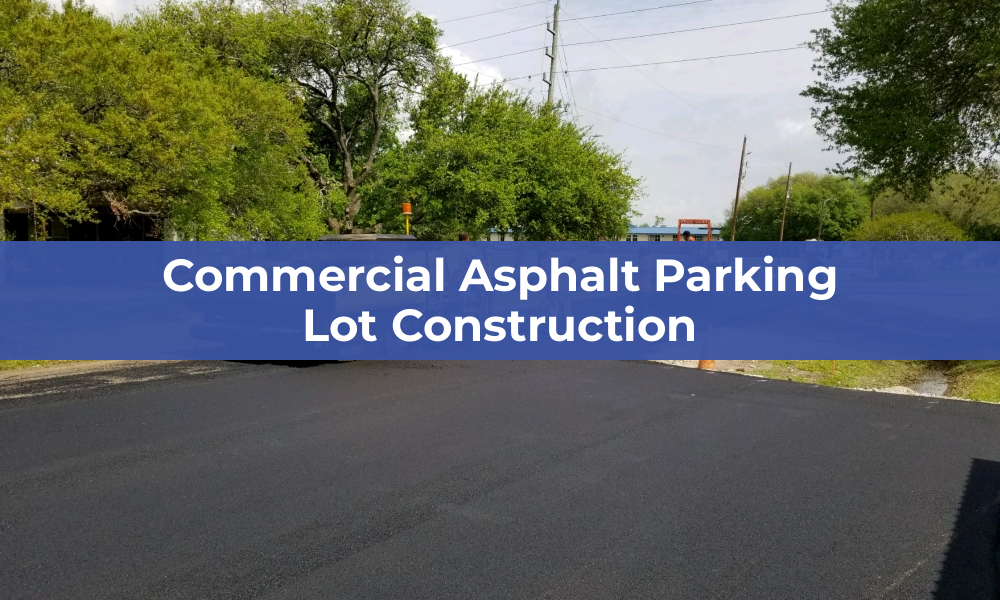
Commercial asphalt parking lot construction is a significant, but necessary, investment for most business owners. A new asphalt parking lot can offer several benefits for commercial properties, including:
- Improved traffic control and efficiency
- Improved pedestrian and motorist safety
- Better curb appeal
- Improved property value
- Improved cost efficiency
Commercial properties need parking lots to function, so the question is why should property owners invest in a new asphalt parking lot? The fact is that there are several benefits to working with a reputable paving crew for commercial asphalt parking lots, including full functionality, increased curb appeal and safety.

Why Should Commercial Property Owners Consider New Asphalt Parking Lot Construction?
If a commercial asphalt parking lot is well-maintained, it should last for more than a decade and provide consistent performance. However, once the asphalt parking lot has reached the end of its useful life, it should be replaced. Allowing a deteriorating parking lot to remain on a property will eventually cause more issues than it is worth.
Specifically, a commercial asphalt parking lot in poor condition may cause the following problems:
- Reduced curb appeal
- Increased liability (damage and injury)
- Traffic congestion and reduced efficiency
- Additional maintenance costs
Property owners can mitigate these problems with a new commercial asphalt parking lot. Here is why new construction makes sense:
Improved traffic control and efficiency
A new asphalt parking lot will smooth out any surface flaws and restore the pavement’s load-bearing capacity. As a result, vehicle traffic will be able to move through the property efficiently. Also, heavy commercial traffic will not stress the pavement as much, which is imperative if the business regularly receives cargo or material.
Improved pedestrian and motorist safety
A well-worn parking lot can place motorists and pedestrians at risk. Tripping hazards may cause injury, and pavement damage may cause motorists to swerve or hit an axle-bending pothole. By replacing a deteriorated parking lot with a new one, the business can avoid injury or damage risks, which is good for liability purposes.
Better curb appeal and property value
New commercial asphalt parking lot construction will boost the property’s curb appeal and the first impression it makes on potential customers or residents. Research shows that a new commercial parking lot also increases property value, as well. The Journal of Real Estate Finance and Economics states that the curb appeal improvement can result in a property value jump of at least 7 percent.
Improved cost efficiency
Multiple departments of transportation around the U.S. have come to the same conclusion: It is far more cost efficient to maintain a parking lot as long as it is in fair to good condition. If the lot deteriorates beyond that, it is more cost efficient to replace the parking lot and maintain the new one to maximize its lifespan.
How is a Commercial Asphalt Parking Lot Built?
New commercial asphalt parking lot construction is an involved process, and the pavement team must have the requisite experience and expertise to do the job properly.
Here is what the job consists of:
A site survey and pavement inspection
Before beginning any asphalt work, the pavement team will first inspect and determine the state of the existing parking lot. They will make note of any potential build challenges, like unstable soils or utilities/subsurface structures. During this inspection, the pavement team will also confirm the project’s scope and determine whether any changes to the build plans need to be made.
Demolition and removal
The existing parking lot will need to be removed first, along with any other obstructions. This is typically done with a combination of hammers, pulverizers, millers and extractors. The demolished asphalt may be recycled and used as material for the new asphalt parking lot.
Base preparation and aggregate placement
Once the old asphalt is removed, the asphalt team will prepare the base, including grading and stabilizing it for maximum drainage and load-bearing potential. An aggregate layer will be installed over the prepared base, typically made from crushed stone. This layer will protect the parking lot from shifting and stress-related wear or damage.
Asphalt installation
With the base and aggregate in place, the next step is to install the new asphalt mix. First, a layer of tack coat is applied to the aggregate base, which will promote adhesion between the base and the new asphalt. The hot mix asphalt will be applied using specialized asphalt paving machines that deposit the asphalt in even layers. Commercial asphalt parking lots are usually installed with a thickness of 3-4 inches and installed in several layers to ensure proper curing.
Compaction and curing
As soon as the asphalt is installed, it is “rolled out” by mechanical rollers that compact the asphalt and maximize its wear and load resistance. Following compaction, the new parking lot will need up to 72 hours to cure before it can be exposed to vehicle traffic.
Striping
After curing, the pavement team should be equipped to stripe the new parking lot. This includes painting on parking lot markings, traffic flow arrows, fire lanes, ADA-compliant markings and access aisles, and any other surface markings the property requires.
If the new asphalt parking lot is installed while observing best practices and receives proper maintenance, it may last upwards of 20 years and provide ongoing value to the property.
Why Should Property Owners Choose a Site Development Team for Their Parking Lot Construction?
If a business is considering a new asphalt parking lot, it is important to work with a pavement team that can also provide site preparation services. Here is why:
A site prep team will ensure maximum subgrade stability
Site preparation experts are masters of soil and base stabilization. They are frequently responsible for creating build plans and performing site surveys, so they have a strong idea of any potential issues before beginning a parking lot project. Further, dirt work teams have access to mechanical and chemical stabilization methods, so they can optimize base stability and performance before the new asphalt is laid on top.
A site prep team will optimize the parking lot’s drainage
Site preparation companies are grading and drainage structure experts. They can read a site plan and accurately assess how water moves through the property following rain. If needed, they can regrade the parking lot’s base to improve drainage and add to existing drainage structures (curb and gutter systems, catch basins, trench drains, swales, etc.) to improve drainage efficiency further.
A site prep team will maximize a parking lot’s useful life
By optimizing the parking lot’s stability and drainage efficiency, the business will get several more years out of the new pavement. A reputable crew can also provide maintenance services, which will ensure the business gets the most out of their investment.
New Asphalt Parking Lot Construction Improves a Property’s Value, Reputation and Liability Protection
If the asphalt parking lot of a business is in noticeably poor shape, it is likely costing the company money. It could be losing money to curb appeal (fewer customers visit the property). It could be losing money to liability issues (ADA violations or damage/injury cases). It could be losing money due to reduced efficiency (traffic congestion or slower loading/unloading processes).
New commercial asphalt parking lot construction can reverse these issues and improve the property’s profitability. Working with an experienced site prep and asphalt team means a business can expect a parking lot that performs for many years.
Commercial Asphalt Parking Lot Construction: FAQs
What are the steps of commercial asphalt parking lot construction?
The job consists of a site survey and pavement inspection, demolition and removal of the existing lot, base preparation and aggregate placement, asphalt installation, compaction and curing, and striping. The pavement team must have the requisite experience and expertise to do each step properly.
How long does a commercial asphalt parking lot last?
A well-maintained commercial asphalt parking lot should last for more than a decade. If a new asphalt parking lot is installed while observing best practices and receives proper maintenance, it may last upwards of 20 years.
How thick is a commercial asphalt parking lot?
Commercial asphalt parking lots are usually installed with a thickness of 3 to 4 inches. The hot mix asphalt is placed in several layers over a tack coat and a crushed stone aggregate base to ensure proper curing.
How soon can vehicles drive on a new asphalt parking lot?
After mechanical rollers compact the new asphalt, the parking lot needs up to 72 hours to cure before it can be exposed to vehicle traffic. Striping takes place after curing.
When should a parking lot be replaced instead of repaired?
It is far more cost efficient to maintain a parking lot as long as it is in fair to good condition. Once the lot deteriorates beyond that point, or reaches the end of its useful life, it is more cost efficient to replace it and maintain the new parking lot to maximize its lifespan.
Can the old asphalt be recycled into the new parking lot?
Yes. During demolition and removal, the existing asphalt is broken up with hammers, pulverizers, millers and extractors, and the demolished asphalt may be recycled and used as material for the new asphalt parking lot.
Why hire a paving contractor that also provides site preparation?
A site preparation team can stabilize the subgrade with mechanical and chemical methods, regrade the base to improve drainage and add drainage structures such as curb and gutter systems, catch basins, trench drains and swales. Better stability and drainage give the business several more years out of the new pavement.

- Commercial Asphalt Parking Lot Construction - October 29, 2026
- Land Grading 101: Why Proper Grading Prevents Costly Problems Later - October 22, 2026
- What to Expect During a Commercial Demolition and Site Clearing Project in Houston - October 13, 2026