
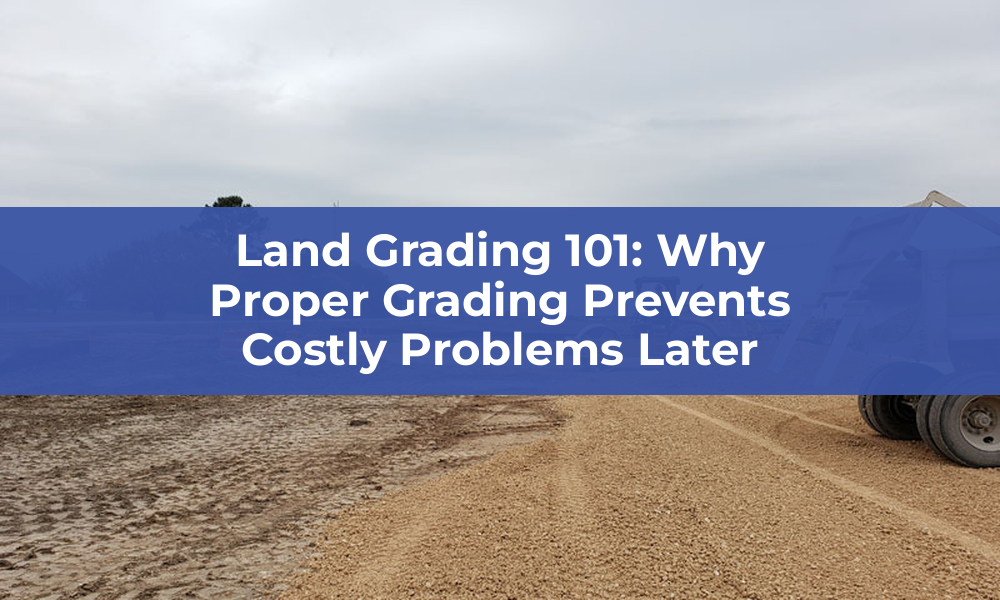
Land grading is an essential part of the site development process, responsible for establishing proper elevations and an efficient drainage slope around any new construction. It is also important for preventing costly problems later in construction, as poor land grading can lead to a variety of issues that can be difficult to correct. Specifically, quality land grading does the following:
- Prevents drainage and standing-water problems
- Protects building foundations
- Reduces soil erosion
- Protects pavement from failure
- Reduces settlement and structural problems
- Protects underground utilities
- Helps maintain compliance with site plans and regulations
- Prevents costly rework during construction
Although land grading is not the first step in a site development project, you can think of it as a foundational step. If it is not done right, you will face unnecessary costs down the road.

How Can Quality Land Grading Prevent Costly Construction Problems?
Land grading is typically scheduled after site clearing and demolition are complete. Once the site is cleared, it can be graded according to the site’s plans. It is critical that this be done with precision, as good land grading can avoid expensive issues through the following:
Preventing drainage and standing-water problems
One of the most important functions of land grading is establishing a drainage slope that funnels runoff away from buildings. If water is allowed to pool and stand for extended periods of time, it will eventually cause damage to building foundations, and the property itself.
Land grading also works in tandem with drainage structures such as curb and gutter systems, catch basins, retention and detention ponds, and culverts to ensure runoff is efficiently captured and removed from the site.
Protecting building foundations
Land grading prevents water damage to building foundations by directing it away from structures. If water does pool around foundations, it will soften the soil surrounding the foundations, causing it to shift or collapse, which puts intense stress on foundations.
Reducing soil erosion
Poor land grading produces slopes that accelerate water flows over exposed soil, which can strip the topsoil and wear in channels. Over time, this will result in excess soil erosion. Soil erosion can destabilize build pads and interfere with other site improvements, leading to additional development costs.
Protecting pavement from failure
Land grading ensures a dry, stable foundation for any pavement, such as sidewalks, walkways and parking lots. This is important for preventing water-related stresses to the pavement, which can result in cracking, potholes, depressions, rutting and other costly issues.
Reducing settlement and structural problems
Land grading is not just about establishing a proper drainage slope. It is also about stabilizing the site with quality fill materials and mechanical/chemical processes. Soil stabilization is essential for minimizing settlement and soil shifting that can exert destructive stresses on pavement and foundations.
Protecting underground utilities
Establishing proper drainage also keeps excess water runoff from affecting water lines, sewer lines, electrical conduits, gas lines and other infrastructure. Without quality land grading, excess runoff can lead to soil settlement and shifting, which threatens those utility lines.
Helping maintain compliance with site plans and regulations
Residential and commercial developments are held to drainage, erosion and stormwater requirements. Land grading is essential for conforming to these standards, which carry costly penalties if they are violated.
Preventing costly rework during construction
If land grading is not properly managed, it will cause a domino effect that interferes with future construction processes. For example, poor grading can affect how building pads, roads, parking areas and drainage structures are installed, and interfere with how they are connected. This is much less expensive to address during land grading, as additional excavation, filling or hauling may be necessary later in the project.
What is Involved in the Land Grading Process?
Land grading is a multistep process that must be completed in order and with precision as a priority. Here is what that process looks like:
Site assessment and surveying
First, the development team will walk the site and assess existing elevations, property boundaries, existing drainage patterns, soil conditions, vegetation, utility lines and anything else relevant to the project. This information is used to create a site plan and assess grading requirements (the amount of fill needed, for example).
Site clearing and demolition
Site clearing and demolition involves removing existing structures and excess vegetation. It is not a part of the actual land grading process, but the site must be cleared first before grading equipment can be mobilized to the site.
Rough grading
Rough grading is when most of the earthmoving takes place. It involves using excavators, bulldozers and other equipment to move soil around the property. The goal is to loosely establish the needed elevations.
Cutting and filling
Cutting and filling is part of the rough grading step and refers to removing soil from some parts of the property and placing soil in others. The idea is to repurpose the “cut” soil during filling, essentially balancing out elevations by moving soil from one spot to another.
Establishing drainage slopes
Once the general grade is created, grading crews will shape drainage slopes for storm drains, detention and retention ponds, culverts and other drainage structures. This is done with careful excavation and bulldozer work.
Fine grading
During fine grading, the final elevations are created to precise tolerances. This involves the use of grading machines, which remove small amounts of soil at preestablished depths. Multiple fine grading passes may be needed to get the desired result.
Verification and inspection
The last step in the process is to verify and inspect all work. This is done by engineers or surveyors on staff.
Quality Land Grading Should be Handled by a Reputable Site Preparation Team
Land grading is a mandatory part of the site development process, essential for stabilizing a build site and ensuring smooth construction. If done right, it will prevent costly issues like unstable soil, foundation/pavement damage and drainage inefficiencies. However, land grading that is executed poorly by inexperienced site developers will cost your organization more in the long run.
The recommendation, then, is to identify a reputable land grading company to manage your project. A proven site developer will have the manpower and equipment resources needed to get the job done on time and within budget. Further, a site development expert will verify their work, ensuring it meets the project’s tolerances and site plan. This will minimize your land grading costs and ensure you have a stable build site to work with.
Commercial Land Grading: FAQs
What is the difference between rough grading and fine grading?
During the rough grade, the site prep team develops the general shape of the property, like hills and landscaped areas. During fine grading, the site’s elevations are precisely crafted with grading machines.
Why is it important to establish drainage away from any buildings or pavement?
Water is a major threat to pavement and building foundations, as it will destabilize the soil around both. Eventually, this will cause the soil to shift, subside and pull away from the pavement/foundation, placing mechanical stresses on it. This can lead to early pavement failure and noticeable structural issues inside the building, like uneven floors or vertical cracks.
What equipment is used in land grading?
Site developers make heavy use of excavators and bulldozers during land grading, as both are efficient earthmoving machines. Other land grading equipment includes scrapers, skid steers, compactors, haulers and motor graders, which sweep an adjustable blade across the soil’s surface to establish accurate slopes and elevations.
When does land grading happen in a site development project?
Land grading is typically scheduled after site clearing and demolition are complete. Once the site is cleared, grading equipment can be mobilized and the property can be graded according to the site plan.
What does cut and fill mean in land grading?
Cutting and filling is part of rough grading. Soil is removed from some parts of the property and placed in others, so the “cut” soil is repurposed as fill. This balances out elevations by moving soil from one spot to another.
Who checks that land grading was done correctly?
The last step in the land grading process is verification and inspection. Engineers or surveyors on staff verify the work to make sure it meets the project’s tolerances and site plan.

- Land Grading 101: Why Proper Grading Prevents Costly Problems Later - October 22, 2026
- What to Expect During a Commercial Demolition and Site Clearing Project in Houston - October 13, 2026
- Paving for HOAs: A Houston Property Manager’s Guide to Parking Lot Maintenance - October 8, 2026