
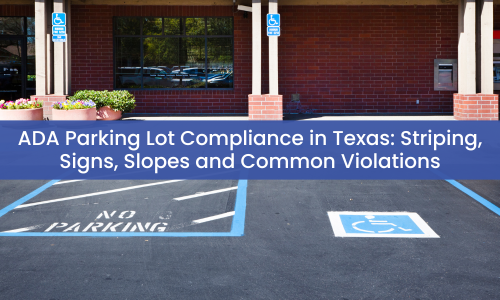
Texas adheres to federal ADA (Americans with Disabilities Act) standards and its own state-level guidance defined in the Texas Accessibilities Standards (TAS). The TAS was designed to complement federal ADA regulations, so there is plenty of overlap where parking lot compliance is concerned, although in some cases, the TAS may be more demanding.
Both the ADA and TAS cover several elements of parking lot design and layout, including striping, signage, grading and positioning. Failure to adhere to these standards may result in severe fines and potential lawsuits or reputational damage.
What Parking Lot Striping is Required for ADA Compliance in Texas?
The ADA and TAS require accessible spaces to be marked (striped) for maximum visibility and to establish boundaries for parking and unloading. Specifically, property owners must ensure the following are in place:
- High contrast markings for all accessible spaces and areas – The ADA and TAS do not specify striping colors, but the colors that are used must be high contrast and provide clear visibility. For this reason, many property owners default to the well-established blue and white tones that are globally associated with ADA accessibility.
- Accessible stalls – All accessible parking stalls must be at least 96 inches wide, and certain van accessible spots need to be larger at either 132 inches wide with an adjacent 60-inch aisle, or 96 inches wide with an adjacent 96-inch aisle. One out of every six accessible parking spaces must be van accessible.
Accessible spaces must be striped with the International Symbol of Accessibility (ISA) to be ADA compliant. - Access aisles – Access aisles must be placed adjacent to each accessible parking space. Each one must be at least 60 inches wide (or 96 inches wide for van accessible spaces). Access aisles must also be marked with diagonal hash marks that extend the width of the aisle to indicate that the aisle is not a parking space.
Accessible parking spaces must be placed as close as possible to the shortest accessible entrance into the building. Access aisles must connect to an accessible path of travel into the building.
What Parking Lot Signs are Required for ADA Compliance in Texas?
To remain ADA and TAS compliant in Texas, property owners must also invest in compliant signage for their parking lots. There are important standards for the signs, including the following:
- ADA signage for each accessible parking space – Every accessible space must have a permanently mounted sign adjacent to the space. The sign must feature the ISA.
- ADA signage that meets mounting height and visibility requirements – The bottom of each accessible parking sign must be mounted at least 60 inches off the ground. Further, the sign cannot be obstructed by parked vehicles.
- ADA signage that denotes van accessibility – Every van accessible sign must be further marked with a “van accessible” designation.
How Should Parking Lots be Graded for ADA Compliance in Texas?
ADA-compliant grading is essential for guaranteeing safe passage for people with disabilities. Those grading specifications include the following:
- Maximum grade – The maximum slope in any direction (longitudinal and cross-slope) cannot exceed 1:48, or about 2 percent. ADA inspections hold tightly to this rule, and even slight excesses can result in fines.
- Curb ramp integrations – Where an accessible route contacts the curb, there must be a curb ramp integration. Curb ramps must be located within or adjacent to access aisles and the maximum ramp slope must not exceed 1:12, or 8.33 percent.
- Drainage considerations – The parking lot must be graded such that water does not pool in accessible parking spaces or access aisles. Further, drainage structures must not interfere with maximum slope requirements, so sloping may not exceed 2 percent even to channel water away from the parking lot.
What are the Most Common ADA Violations for Texas Parking Lots?
Property owners are expected to maintain tight compliance with ADA and TAS standards, and any violation could result in a severe fine. Those fines scale up with multiple violations, so if your parking lot is not installed by a contractor who observes those standards, it could be an extremely expensive mistake. Further, your parking lot will need to be redesigned or reinstalled to meet standards, adding to your costs if the pavement is not in compliance.
Here are some of the most common ADA violations that reputable paving contractors take seriously when installing a parking lot:
- Not enough accessible parking spaces – In Texas, parking lots must include a certain number of accessible parking spaces based on the total number of spaces in the parking lot. For example, a parking lot with 100 total spaces must have at least four accessible spaces, while a parking lot with 500 total spaces must have at least nine accessible spaces. For any parking lot with more than 500 spaces, at least 2 percent of the spaces must be ADA accessible.
- Improper placement of accessible parking spaces – Accessible parking spaces must be located on the shortest accessible route to the building entrance. If they are placed away from this entrance, it is a violation.
- Improper sloping or grading – Excessive sloping due to poor paving or overlaying practices may also result in a violation. Even a slope in the 2.2 percent or above range is enough to trigger fines.
- Improper access aisle design – Missing access aisles, aisles that are too narrow or aisles that do not span the full parking space length are also common ADA violations and will require a redesign.
- Missing or improperly installed signage or striping – Missing ADA signage, damaged ADA signage or ADA striping that has faded can also result in violations.
- Uneven or damaged pavement in accessible areas – If the pavement in accessible parking areas or along accessible routes is damaged or uneven to any extent, it may be considered a violation. For this reason, it is important for property owners to inspect their pavement regularly and ensure it is not developing issues along accessible routes. A pavement contractor can assist with this.
How Can a Pavement Contractor Ensure ADA Compliance in Texas?
An experienced Texas pavement contractor will also have experience installing parking lots within ADA standards. That includes striping accessible areas, ensuring proper curb and pavement transitions, grading with precision and installing ADA-compliant signage.
ADA violations can add up quickly and cause extreme financial stress for property owners, all over avoidable issues with a parking lot. To avoid those issues, work with an accomplished pavement contractor to ensure everything is done to standard.

- Commercial Parking Lot Striping: ADA Requirements Every Houston Business Must Know - September 10, 2026
- Fall Parking Lot Prep: Sealcoating and Crack Repair Before Winter in Houston - September 3, 2026
- The Benefits of Asphalt Milling Before Repaving a Houston Parking Lot - August 28, 2026