
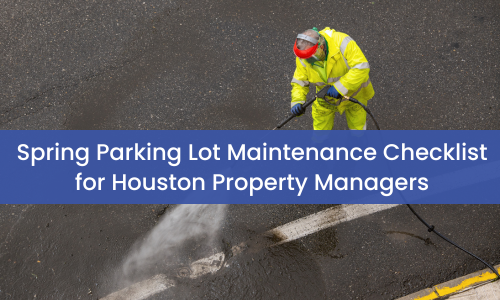
During the Spring, the weather in Houston gets warmer and wetter, and that means it is time for property owners to focus on parking lot maintenance. The goal is to prepare the pavement for water and heat-related stresses, as both can affect the parking lot’s performance, appearance and long-term durability.
What Should Property Owners Consider for Their Spring Parking Lot Maintenance Checklist?
Parking lot maintenance is largely focused on drainage and spot repairs in the Spring, as this will fortify the pavement against intense UV rays and rainfall. Warm weather is a great time to review your parking lot maintenance checklist, and it is also an ideal time for paving contractors to perform more complete repairs and maintenance.
Here is what a Spring parking lot maintenance checklist should include:
-
A full, detailed inspection - Houston winters are not known for regular ice and snow events, but the cold can stress pavement in ways that are not always obvious during the Spring and Summer. Therefore, it is a good idea to check all of the parking lot’s elements before planning maintenance.
The inspection should include a complete walkover of the parking lot, taking note of any wear, damage or signs of aging. Check the drainage structures (catch basins, storm drains, inlets, trenches and grates) for any obstructions or vegetation growth. Make sure that the curbs and sidewalks are still intact and note the condition of any signage and striping. - Clearing all drainage structures - It is critical for Houston property owners to maintain efficient drainage in their parking lots year-round. If drainage structures are obstructed in any way, it can lead to flooding on the property. To avoid this scenario, it is important to clear all litter, leaves, branches, mulch, sediment and other debris from all drainage areas as soon as possible.
- Removing any and all debris in the lot - Cleaning efforts should extend to the parking lot itself as well. To avoid debris being washed into drainage structures and forming a clog, schedule a round of power sweeping (and consider scheduling it every 2-4 weeks) to get rid of trash and organic debris from the parking lot.
- Checking for any ponding water - If water is ponding on the parking lot, that could be a sign that the pavement is warping in places or is not draining like it should. Following a rainstorm, check if water is ponding anywhere on the parking lot or is not flowing into certain drainage structures as efficiently as it should. If it is, the parking lot will likely need a surface treatment or spot repair.
-
Spot crack and pothole repairs - Significant cracking and potholes are weak spots in a parking lot, allowing water and dirt to reach the pavement’s deeper, more vulnerable layers.
During Spring maintenance, invest in crack filling and pothole patching services. If necessary, the parking lot may require a surface course treatment, like an overlay or asphalt milling. - Evaluating whether sealcoating is required - Asphalt pavement is occasionally sealcoated to provide extra protection against UV radiation, wear and weather. Sealcoating is a proven way to extend a parking lot’s lifespan and reduce maintenance costs over time. This process is recommended every 12-24 months, depending on how much traffic the parking lot receives and prevailing climate conditions. The pavement team can determine whether or not it is time for the parking lot to be sealcoated.
- Restriping any faded markings - Frozen precipitation and surface wear will eventually wear away at the parking lot’s markings, including parking spot lanes, fire lanes, accessibility symbols, access lanes and more. Clear striping is required by law, so if the lot’s markings have worn away, it is time to schedule professional parking lot striping.
- Addressing vegetation overgrowth - Overgrown vegetation can interfere with drainage and cause damage to the parking lot if it penetrates the pavement. Clear away any overgrowth along the parking lot’s perimeter and any vegetation intruding into drainage structures.
If Houston property owners get to every item on this list, their parking lots will be ready for the busy and wet months ahead.
How Does Consistent Parking Lot Maintenance Save Houston Property Owners Money?
Many Houston property owners put off their parking lot maintenance thinking that there will always be time to catch up. However, this is a gamble because minor pavement issues can rapidly become major problems. Here is why it is best to address issues as they arise:
- The data shows waiting on pavement maintenance is always more expensive – Multiple state-level departments of transportation have studied pavement maintenance costs and generally come to the same conclusion: The longer property owners wait to address damage, the more it will cost to address any issues.
It is always less expensive to keep pavement in good condition than it is to restore it from poor to fair condition. When Houston property owners are proactive with parking lot maintenance, it will cost less in the long run. - Cracks and potholes permit deep water intrusion – Water is pavement’s primary enemy, especially once it penetrates through the parking lot’s surface. If water is allowed to reach the parking lot’s subsurface layers, it will eat away at the binders holding the pavement together. It can also cause base subsidence, which can lead to collapsing pavement in spots. Addressing those cracks and potholes will minimize the risk of water intrusion and, by extension, major parking lot damage.
- Damaged drainage structures can cause catastrophic flooding – If the drainage structures are damaged or jammed up with debris, the resulting backflow may spread beyond the parking lot and flood other parts of the property. This can lead to oversaturated landscaping areas, slick walkways, pests and eventual foundation damage.
- Parking lot issues can lead to liability – If a parking lot is uneven, warped or badly marred by cracks or potholes, it may injure pedestrians or damage vehicles. In both cases, the Houston property owner may be held liable for the damages.
By addressing parking lot maintenance on time (or early), property owners can avoid the above issues and an unexpected hit to the budget.
Spring is Here, so it is Time to Consult with a Reputable Paving Team
If it has been a season or two since parking lot maintenance has been considered, the Spring is the best time to complete the checklist. After evaluating the lot, be sure to schedule essential maintenance, whether it is a layer of sealcoat, crack/pothole repairs, a new drainage structure or just a round of cleaning and striping. No matter what condition a parking lot is in, maintenance will slow down the wearing process and maximize the pavement’s life and value.

- Paving for HOAs: A Houston Property Manager’s Guide to Parking Lot Maintenance - October 8, 2026
- Commercial Parking Lot Striping in Houston - October 2, 2026
- What is Soil Stabilization and Why Does Your Houston Project Need It? - September 24, 2026