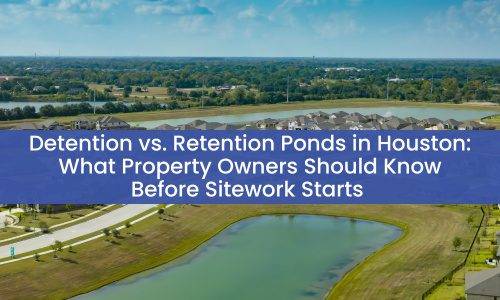
Detention and retention ponds are vital drainage structures that are particularly useful for Houston properties, where heavy storms and large volumes of runoff are common. Detention and retention ponds are an excellent option for capturing that runoff and ensuring it is sent down controlled drainage channels.
If properly constructed, retention and detention ponds can protect Houston properties from flooding, foundation damage and soil instability, which can cause issues for anything sitting on the surface. However, property owners must observe regulatory and permitting standards before beginning excavation, and working with a reputable site development crew ensures work will be completed properly.
What is the Difference Between a Retention and Detention Pond in Houston?
Retention and detention ponds essentially serve the same purpose for Houston property owners. They are designed to mitigate flooding by serving as a containment and drainage structure for properties. However, there are subtle differences between the two:
Detention Ponds
Detention ponds are primarily a drainage structure, as they only hold stormwater temporarily. Beneath the surface, detention ponds are designed with a riser that channels outflow through a culvert that runs to a storm sewer.
Retention Ponds
Retention ponds are primarily a volume control structure, designed to hold large volumes of water on a permanent basis. Retention ponds slowly release stormwater through evaporation, or perhaps a small riser and culvert that gradually releases small volumes of water. Retention ponds are good for controlling water quality and can be an aesthetic feature for Houston properties.
What Do Houston Regulations Require Prior to Detention or Retention Pond Sitework?
Drainage planning is mandatory for Houston properties. As one of the most flood prone cities in the U.S., ignoring drainage patterns may eventually lead to potential flooding on the property. Retention and detention ponds are proven options to prevent this flooding, but before they can be installed, there are regulations that Houston property owners must observe. For example:
- Detention volumes – Retention and detention ponds must detain a volume of water relative to the size of the property and how much of the property will be disturbed by construction. For example, for lots smaller than 15,000 square feet that will disturb more than 65 percent of the lot, detention rates must be at least .75 acre-ft per acre. Houston’s detention rates have nearly quadrupled since 2021, and property owners must be aware of this before drawing up drainage plans.
- Design standards – There are numerous design standards that property owners must observe, in addition to retention rates. The retention/detention pond must also be sloped with the right grade (between 3:1 and 4:1). It must be excavated to sufficient depth to account for major storm events. It must be designed with overflow margins for additional safety. Any spillways must be routed for safety as well.
Houston also requires property owners to build in stormwater quality treatment features into retention or detention ponds. Examples include sediment forebays and vegetated edges of shelves.
It is important for Houston property owners to observe these standards to avoid any retention/detention pond installation delays or interruptions.
- Discharge rates – Discharge rates are tightly controlled, though there is not a one-size-fits-all approach to how they are managed. Houston requires property owners to control outflow and ensure there is no downstream risk of flooding. This must be demonstrated with engineering proof, confirming that the property’s infrastructure will not be overwhelmed by a major rain event.
What Should Houston Property Owners Keep in Mind During the Permitting Process for a Drainage Pond?
Retention and detention pond projects must be permitted before work can begin. To attain that permitting, the following are required:
- Drainage plan approval – A drainage plan must be compliant with Houston’s Infrastructure Design Manual (IDM) and with Harris County’s flood control specifications. These outline design features that retention or detention plans must include to mitigate Houston’s flood prone nature.
- Stormwater quality permit – Houston properties must maintain a certain level of stormwater quality, which may be influenced by erosion, nearby vegetation, sedimentation or further development in the area. Annual inspections are required to maintain this permit.
- Integration with existing infrastructure – The retention or detention pond will be integrated with the existing infrastructure. That means property owners need to account for existing storm sewers, any culverts and storm trenches and for any downstream capacity that the owner will be responsible for. The retention/detention pond plan will need to account for these factors before permitting is granted.
What are the Major Cost Factors for Retention and Detention Ponds in Houston?
Retention and detention ponds come with a significant cost, though they are far less expensive than correcting flood damage. When drawing up a plan, the following factors will influence the project’s final cost:
- The pond’s size and land consumption – The larger the pond, the more it will cost to excavate. For commercial properties, it is worth considering how much buildable area will be taken up by the pond, as this will impact the function and potential profitability of any commercial buildings. An expert site development crew can help design the pond for maximum retention volume while mitigating its footprint.
- Excavation and grading complexity – Retention and detention ponds require extensive grading and sloping, along with carefully considered drainage pathways. Complex excavation and shaping will require additional work and factor into the project’s cost.
- Soil and groundwater conditions – Unfavorable soil and groundwater conditions may result in delays and require additional site development work like soil stabilization services. For example, Houston features clay rich soils and a high water table, which are common issues that make excavation more difficult. This can also affect project costs.
Work with an Experienced Site Development Team to Optimize Drainage Investments
The most effective way to guarantee sufficient drainage while controlling your project costs is to work with an expert site development team. Experienced site developers will ensure all regulatory benchmarks are met and have engineering expertise on staff to prove the plan’s safety and flood control capacity. Further, experienced site developers have access to additional machinery assets, including additional excavators and graders for precision construction.
Retention and detention ponds are essential drainage structures and protection measures for every Houston property. If you are developing a residential or commercial property in Houston, consult with a proven site development company to assess your retention and detention pond options.