
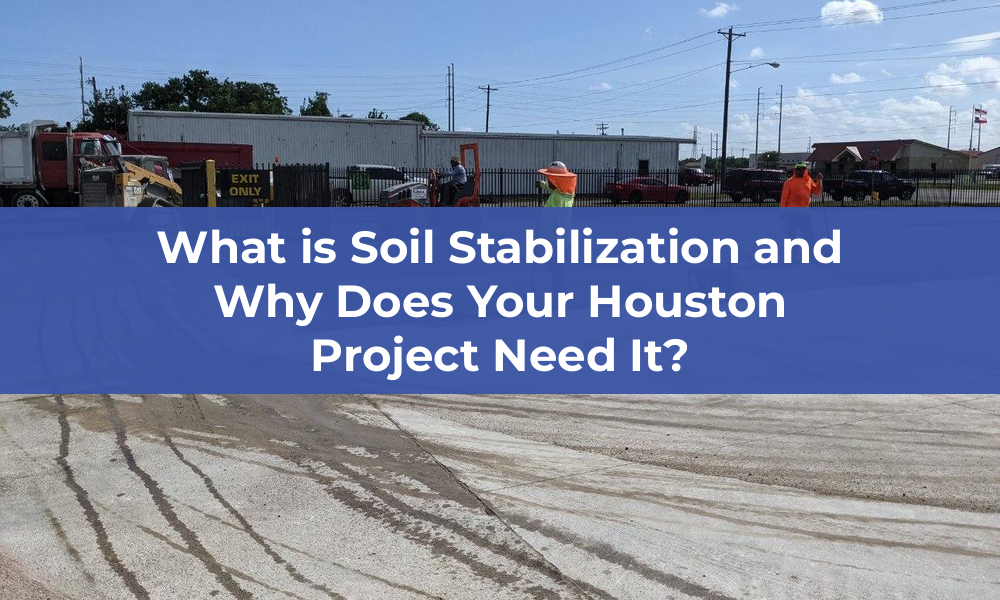
Soil stabilization is a critical site preparation process for Houston construction, whether your project involves new pavement or structures. Even the best designed and best constructed pavement, foundations or buildings will falter if they are constructed on unstable soils. With soil stabilization, your build site will provide the following:
- More predictable soil behavior
- Improved load bearing capacity
- A uniform construction platform
- Better settlement control
- More reliable drainage control
- Extended pavement and building longevity
- Improved project efficiency
- Reduced post-construction maintenance
Add up each of these important factors and it is clear that soil stabilization services add value to every Houston project.
Why are Soil Stabilization Services Important for Houston Building and Paving Projects?
There are several critical reasons why your organization should invest in soil stabilization services before beginning development, including:
More predictable soil behavior
Unstable, moisture sensitive soils are common in Houston. If left untreated, these soils will swell and shift with every rainstorm, applying intense stress on the buildings’ foundations and on the pavement. Soil stabilization reduces this swell and shrink cycle so the soil behaves in more predictable ways, even when exposed to inclement weather.
Improved load bearing capacity
Soil stabilization enhances load-bearing capacities for slab-on-grade foundations, light commercial foundations, warehouse and industrial floors, equipment pads, loading docks and any pavement. The soil must withstand these loads without excessive deformation, compression or shearing. Soil stabilization prevents those issues from occurring.
A uniform construction platform
Soil conditions vary greatly across Houston. Some areas are characterized by rigid soils, while others are covered in soils with high organic content. This makes it difficult to predict how foundations or pavement will hold up around the city. Soil stabilization creates uniform density, plasticity, strength and stiffness characteristics, providing a predictable platform for construction.
Better settlement control
In some parts of Houston, the soil is loose and prone to settling and consolidating under loading. Loose soils are a liability when built upon, as collapsing soils will create stresses inside the pavement or foundation. Soil stabilization compresses the soil and removes settlement potential from the build site.
More reliable drainage control
Drainage is a critical aspect of site development, especially in Houston where heavy rains can quickly overwhelm a poorly draining property. Unstable soil may rut or settle after grading, resulting in drainage issues such as depressions. Soil stabilization helps maintain pavement cross slope, elevations, curb grades, sidewalk alignment and other essential drainage structures.
Extended pavement and building longevity
Soil stabilization improves the subgrade’s load bearing capacity and deflection resistance. Further, it limits moisture related strength loss and helps maintain drainage slopes. Collectively, this improves the pavement’s long-term durability and ensures it provides maximum value.
Improved project efficiency
Poor soil stability is not just an issue after construction is complete. It is a problem during construction, as poor soils will affect how machinery moves through the project site and how easily it can be graded. Soil stabilization creates a site that equipment can navigate without incident, and a site that crews will not have to struggle with during site preparation work.
Reduced post-construction maintenance
If new construction is built on unstable soils, it will inevitably force additional maintenance as stresses build up in the foundation. For example, this could mean structural cracks that force significant reworking of the site. With soil stabilization, you will protect your investment over the longer term.
If you are working with an experienced site development team in Houston, they can deliver all of the above when stabilizing your build soils.
How Do Pavement Contractors Stabilize Soils in Houston?
Site development contractors rely on mechanical and chemical methods to stabilize soils, and they may be used in tandem to maximize the site’s stability. Those methods include:
Mechanical stabilization
Mechanical stabilization includes soil compaction, removal and replacement (cutting and filling). During cutting and filling, low quality build soils are removed from the site and replaced with soils that will bear weight better. Geosynthetics, like geogrids and geotextiles, are another mechanical form of stabilization that involves placing a layer of stable synthetics in the soil. This layer is designed to distribute weight, improving the soil’s overall performance.
Chemical stabilization
Chemical stabilization includes adding lime or fly ash (or a combination of the two) to alter the chemical properties of the soil and help it bond better. Chemical stabilization is excellent at reducing soil plasticity and shrink/swell behavior, while improving workability.
Choose an Experienced Pavement Contractor for Your Soil Stabilization Needs
If your organization is developing a site or about to begin construction, do not neglect the soil stabilization phase. The process is critical for imparting favorable build characteristics and ensuring your new construction delivers maximum value and longevity.
There cannot be any cut corners during soil stabilization, as allowing even a small patch of untreated soil to remain will open up potential vulnerabilities on your site. That means partnering with an accomplished, reputable site development team to manage every phase of the project, from land clearing to final grading, and soil stabilization. With an experienced crew on the project, you will get the best build site for your construction possible, no matter what type of soils you are working with.
Soil Stabilization in Houston: FAQs
Why do Houston soils frequently require stabilization?
Houston’s proximity to the coast means a high water table and organic-rich soils that are particularly difficult to build on. This includes expansive clay soils that swell and shrink with every rain cycle, as well as high-settlement soils. Soil stabilization is essential for imparting the right load-bearing characteristics into these soils, and to protect build sites from Houston’s wet weather.
What equipment is used during soil stabilization?
Soil stabilization is handled with a combination of rollers (compactors), excavators, bulldozers and a variety of specialized stabilization equipment. Examples include soil reclaimers (cuts and pulverizes the soil), lime/aggregate spreaders, graders and more.
How does soil stabilization improve drainage efficiency?
Soil stabilization services remove low quality build soils, many of which are either overly permeable or impermeable (both adversely affect drainage). During soil stabilization, the site’s grading is addressed, and an efficient drainage slope is re-established to ensure water drains efficiently.

- What is Soil Stabilization and Why Does Your Houston Project Need It? - September 24, 2026
- Commercial Parking Lot Striping: ADA Requirements Every Houston Business Must Know - September 10, 2026
- Fall Parking Lot Prep: Sealcoating and Crack Repair Before Winter in Houston - September 3, 2026