
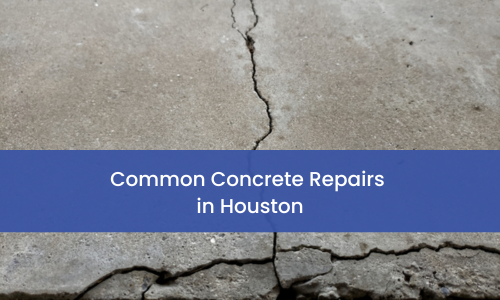
Concrete is extremely durable, resistant to weather-related stresses, offers superior load-bearing potential and generally lasts longer than other forms of pavement in Houston. However, property owners will eventually need to invest in common concrete repairs including:
- Concrete crack sealing and repair
- Concrete grinding
- Concrete resurfacing
- Concrete joint replacement
- Concrete slab replacement
If property owners invest in basic but common repairs before concrete damage has a chance to worsen and spread, repair costs can be minimized over the pavement’s lifespan.
What are the Most Common Types of Concrete Repairs in Houston?
All pavement eventually takes on wear and damage. The difference between concrete that fails early and concrete that lasts is how property owners respond to that damage. Prompt concrete repairs are important to extending the pavement’s performance and useful life, and those repairs include:
Concrete Crack Repairs
Crack fixing is the most common type of concrete repair, but there are many ways it can be done. Before your pavement contractor settles on the right method, they will consider several factors, including the crack’s width and depth, where the crack is located, whether water intrusion is likely, whether the crack is near a load-bearing area and whether the crack is likely to flex under thermal stresses. Once those factors are assessed, your concrete team will know which repair option to go with.
Concrete crack repair methods include crack sealing, epoxy/polyurethane injection, patching and stitching. Crack sealing is for hairline, non-structural cracks, and involves routing the crack, cleaning it out and applying a silicone or polyurethane sealant to the pavement’s surface. Epoxy/polyurethane injections are for foundation, structural slab or vertical cracks, and involve drilling injection ports into the concrete before injecting the compound under heavy pressure. Patching is for non-structural cracks that are larger than cracks that can be easily sealed. During patching, the crack is routed out before a modified repair mortar (augmented with polymers) is layered over the crack.
Stitching is a heavy-duty, mechanical form of crack repair appropriate for long or deep structural cracks and commercial slabs. During stitching, holes are drilled on both sides of the crack, then steel hooks (or “staples”) are driven into the holes, so they are straddling the crack. The holes are filled with a grout compound, and once finished, the stitches will hold the crack closed.
Concrete Grinding
Concrete grinding is like the pavement version of sanding down a surface. In Houston, it is typically recommended when tripping hazards emerge on sidewalks, which is the product of root intrusion or shifting slabs.
Pavement teams use concrete grinders to reshape the concrete’s surface and smooth out any irregularities that may cause trips. It is a simple form of repair that can be done quickly, but it is not appropriate for anything other than minor reshaping applications.
Concrete Joint Replacement
Concrete joints are installed for various reasons. Control joints minimize shrinkage cracking. Isolation joints separate fixed concrete from independent slabs. Expansion joints will need to occasionally be repaired, as they fill an important role throughout the pavement’s lifespan, allowing the pavement to flex when subjected to thermal stresses.
Expansion joint repairs are a common concrete repair in Houston, as the city’s extreme heat and rainfall will eat away at the joint filler. In general, joint repairs are typically needed every 3-5 years, though it depends on environmental and traffic factors.
During concrete joint replacement, each expansion joint is reformed (if necessary) and cleaned out using vacuums, power washers or heat lances. Once the joint is ready, new polyurethane filler is inserted into the joint.
Concrete Resurfacing
Resurfacing concrete is difficult and is not effective at resolving structural issues, so it is reserved for cosmetic or surface level issues only. However, resurfacing the concrete will resolve superficial cracking and improve the pavement’s appearance.
During resurfacing, the pavement team will first inspect the concrete to verify that any damage can be addressed with an overlay. If an overlay is recommended, the pavement surface is first pressure washed and grinded to improve adhesion with the new overlay. Any cracks and failing joints are then repaired, a bonding agent is applied to the pavement surface, and the overlay is then installed. If the concrete is intended for decorative applications, it is textured or stamped following installation and curing, and then the pavement is sealed to promote long-term weather resistance.
What Are Some Signs That Your Houston Concrete Needs to be Replaced?
Concrete repairs will ensure property owners get maximum value from their pavement, and if it is well maintained, concrete pavement can last for decades. Eventually, you will need to consider replacement if your pavement is noticeably deteriorating. If you are considering concrete slab replacement, here are some signs to look for showing it may be time:
- Multiple deep cracks, or cracks that threaten the concrete’s stability
- Slab heaving or settling that affects the slab’s levelness
- Deep spalls or surface delamination
- Signs of foundation or structure damage
- Poor installation techniques
- Repeated repairs and mounting repair costs
- Drainage issues that can’t be easily addressed
Houston’s unstable, clay-rich soils and intense rainfall are more likely to cause issues like settlement and heaving, and its heavy traffic can result in impact or weight related cracking.
Who Should Property Owners Contact if Their Concrete is Damaged or Worn?
If your concrete has sustained significant wear or damage, it is imperative to consult with an experienced pavement contractor and request an inspection. During an inspection, your pavement team will assess the state of your concrete and determine whether repairs or replacement is the appropriate option. If repairs are recommended, the pavement team will identify the optimal repair methods for your concrete. The important point is to act quickly if you do notice signs of damage or wear, as this will ensure the concrete is preserved before it deteriorates and is more expensive to address.

- Paving for HOAs: A Houston Property Manager’s Guide to Parking Lot Maintenance - October 8, 2026
- Commercial Parking Lot Striping in Houston - October 2, 2026
- What is Soil Stabilization and Why Does Your Houston Project Need It? - September 24, 2026