
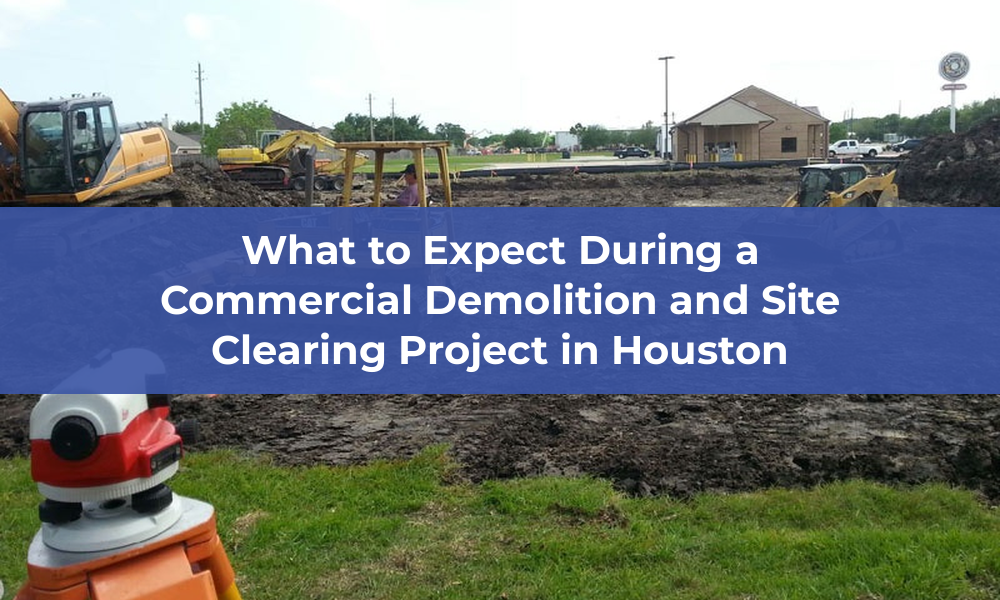
Commercial demolition and site clearing projects are involved, multi-step processes that require specialized expertise to manage. If a site is being developed for commercial purposes, working with a well-resourced contractor is the best way to make it happen. When working with a site development expert, here is what can typically be expected during the job:
- Site assessment and planning
- Utility disconnection
- Structural demolition
- Debris removal (and material recycling, if possible)
- Site clearing and excavation
- Rough grading
- Dust, noise and traffic management
Once these processes are complete, the site will be ready for further commercial development, including detailed grading passes, drainage construction and installing foundations.
What Does the Commercial Demolition and Site Clearing Process Include in Houston?
Demolition and site clearing are essential parts of the development process in Houston. A lot of commercial development in the city is built on unstable soils or are intended for properties with existing structures. In both cases, expert demolition and site clearing can resolve any issues and prepare the space for new construction.
If a business is about to start the commercial site development process, here is what to expect:
Site assessment and planning
Before any dirt work begins, your site development team will first walk and assess the site. This is important to identify any potential blockers or hazards during demolition and site clearing. This could be unstable soils, poor drainage patterns, underground utilities, hazardous material or something else.
Once the site is assessed, the dirt work team will draw up a site plan that details what is present on the site and how the project will proceed. These plans may be used to secure permitting. Soil samples will likely be taken during this part of the job, as well.
Utility disconnection
During site assessment and planning, the dirt work crew will determine where any utility lines are present. If there are active utility lines on the project site, they will need to be safely disconnected. This could include electrical, natural gas, water, telecommunication and sewage lines. A reputable demolition and site clearing contractor will never make assumptions about utility lines.
Structural demolition
If there are existing structures on the site, they may contain hazardous materials like asbestos. If so, the demolition team will need to employ specialized removal and disposal processes to safely deal with those materials.
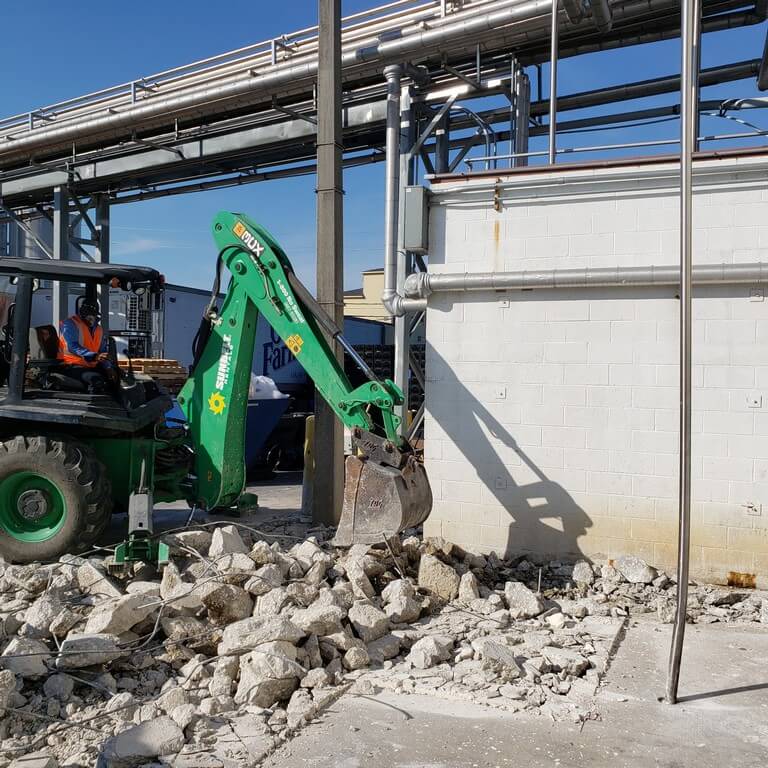
Once hazardous materials are removed, structural demolition can begin. During demolition, the site developer will mobilize extractors, hydraulic breakers, bulldozers, dismantlers, skid steers and haulers to the site. They will work together to dismantle and knock down structures. If targeted demolition is needed for safety purposes, crews with hand-held demolition tools may be necessary. As structures are removed, the material is hauled offsite.
Debris removal (and material recycling, if possible)
Most demolished materials will end up in the landfill, ferried there by hauler trucks that the demolition team will have on standby. However, concrete and asphalt can be recycled (or at least repurposed), so if the project includes demolishing pavement, some of that material may still be of use. Concrete, for example, can be broken down to create aggregate for new pavement, while demolished asphalt can be used as feedstock for fresh asphalt.
Site clearing and excavation
Once any existing structures are removed, the site preparation team can clear the entire site of any excess vegetation, trees, rocks and anything else that would interfere with construction. In Houston, most site clearing efforts are directed at removing trees and shrubs, which can be done with extractors or bulldozers.
If there are any underground structures, foundations, utility lines or holding tanks (like septic tanks), they will be excavated out of the ground using extractors.
Rough grading
Detailed grading typically follows site clearing, but during the site clearing process, the site prep team may perform a rough grade that generally establishes the desired elevations and shape of the developed site. This will be defined on the site plan, so it is clear how the process will be executed upfront.
During a rough grade, extractors will cut poor quality soils and fill them with stable alternatives (aggregates instead of organic soils, for example). Heavy machinery will also be used to create slopes and dig out areas for retention and detention ponds or other water features. The goal is to create the foundation for additional grading passes that will develop desired elevations with better precision.
Once the project reaches this point, the site will be close to being ready for actual construction.
What Comes After Commercial Demolition and Site Clearing?
Following demolition and site clearing, the space will be ready for the later parts of the site prep process, right before construction begins. That includes:
Additional grading passes
Following demolition and site development, the dirt work team will finalize the site’s grade during several grading passes. This starts with larger scale cutting and filling, then moving to final grading that relies on grading machines to shape each slope down to the inch.
Drainage construction
Drainage is critical in Houston, where heavy rains are common and are often severe enough to cause extensive water damage to unprotected properties. Part of drainage control is grading the property and ensuring water flows away from structures. However, another part of the job is building out drainage structures that capture and redirect runoff. This includes curb and gutter systems, catch basins, retention/detention ponds and more.
Building pad placement
Once the site is graded, each build site will need a stable building pad to allow for durable construction. This includes stabilizing the subgrade via mechanical or chemical means to impart the needed load-bearing characteristics into the soil.
Pavement construction
In addition to building foundations and drainage structures, the property may require additional pavement like sidewalks, walkways or parking lots. Many demolition and site clearing contractors are also qualified to install pavement and can place it after the site is completely prepared.
After the above has been completed, the site is ready for the planned structures.
Commercial Demolition and Site Clearing Requires a Reputable Contractor
Commercial demolition and site clearing can be hazardous work, and it requires extensive machinery and manpower resources. These are also processes that must be managed with best practices, as any errors during site clearing or demolition can lead to major construction delays down the line.
If an organization is developing a raw piece of land for commercial purposes, the right move is to partner with an experienced demolition and site development contractor. Expert crews have well-established logistics in place, ensuring the necessary materials and machinery are available at every step of the process. They also know what to do if hazardous materials or utility lines are present on the site. Experienced contractors can seamlessly transition from site clearing to other site development processes, like grading or foundation installation.
Commercial site development is an important and involved process, so it is vital to choose a team with plenty of experience and a strong reputation.
Commercial Demolition and Site Clearing in Houston: FAQs
What do demolition contractors do if there are hazardous materials at the site?
If hazardous materials like asbestos are uncovered at a demolition site, work in that area will stop and the contractor will evaluate the material. This may include laboratory analysis. The work area will then be isolated to prevent the hazard from spreading, and abatement will begin. Once the material is removed, it is contained and hauled off in a separate waste stream.
How do site clearing contractors remove tree roots?
Site clearing contractors may utilize a process termed “grubbing” to remove root structures from the site. This involves digging out the roots via extraction or by attaching a chain to the tree and uprooting it with a bulldozer.
Can demolition contractors recycle or reuse any demolished materials on site?
In some limited cases, a demolition contractor may be able to capture demolished material and repurpose them for new construction. This is most commonly the case when demolishing pavement like concrete or asphalt.

- What to Expect During a Commercial Demolition and Site Clearing Project in Houston - October 13, 2026
- Paving for HOAs: A Houston Property Manager’s Guide to Parking Lot Maintenance - October 8, 2026
- Commercial Parking Lot Striping in Houston - October 2, 2026