
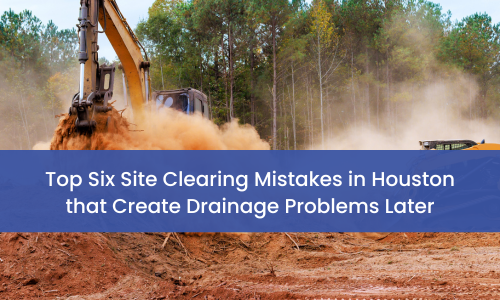
The site clearing phase is vital in preparing for a successful land development project. If site clearing is not executed properly, it will lead to numerous issues during the project’s latter stages, and these issues can lead to drainage problems.
Six of the most common site clearing mistakes that create drainage problems include:
- Clearing the site without a grading or drainage plan
- Removing too much vegetation or removing it too quickly (especially around water)
- Altering natural drainage features instead of leveraging them
- Failing to control erosion and sediment flows
- Clearing the site with poor use of heavy machinery
- Grading and altering the site without engineering oversight
If these mistakes are made and lead to drainage problems, they will threaten foundation work and the property’s pavement.
How Do These Six Site Clearing Mistakes Lead to Drainage Problems in Houston?
Any of the following site clearing mistakes can lead to drainage problems later, but an expert site clearing contractor can avoid them:
- Clearing the site without a grading or drainage plan – No matter what stage of the land development process the site is on, executing it without a plan is risky. That includes the grading phase, where precise elevations are necessary to facilitate efficient drainage throughout the property.
Drafting a site plan with engineering assistance is one of the first things that your site development contractor should do when they take on the project. This site plan includes elevation specifications at every part of the property, and these elevations are designed to optimize drainage. If your site development crew does not take site planning seriously, they will inevitably make mistakes during grading that lead to drainage problems. - Removing too much vegetation or removing it too quickly – A common mistake that site clearing teams make is going overboard with removing vegetation. Trees, shrubs and grasses are a natural hedge against erosion as they reduce surface runoff velocity and reduce the amount of water that is absorbed by the soil, which is what causes that soil to become unstable. It is critical that your site development contractor identify what vegetation is playing an essential role for the property’s drainage, ensuring the ground is not overwhelmed by rainfall once the site is cleared.
- Altering natural drainage features, instead of leveraging them – Some development sites have natural features that can assist with drainage if they are leveraged. This includes channels and low spots on the property. An experienced site clearing and development team will use these features to your advantage. However, too many site developers choose to fill or flatten them out, which may alter water movement through the property in negative ways. It can also redirect runoff where you do not want it, like around your structures.
- Failing to control erosion and sediment flows – Your site development contractor may need to implement erosion control methods once the site is graded, which could include physical barriers like fences. It could also include vegetative methods like mulching or seeding or could include runoff management structures like basins or retention/detention ponds.
If these erosion controls are not put in place, runoff sediment may clog the drainage structures you do have in place, like culverts and storm drains. - Clear the site with poor use of heavy machinery – Grading requires heavy machinery, and extractors and dozers are just part of the process, but if they are not utilized properly on your site, they may create ruts or depressions that collect water. They may also inadvertently compact the soil too much, which leads to poor draining and low water infiltration. Some degree of soil compaction is necessary to minimize erosion and improve site stability, but it is possible to go overboard with this process. That is why experienced site development crews carefully and thoughtfully consider site access.
- Grading and altering the site without engineering oversight – Every site development project should be executed with engineering oversight. An engineer will assess the slope of any grades and where those slopes should be placed to ensure runoff goes where it is intended (and at the right speed). Without engineering oversight, there is a high likelihood that your site developer will make mistakes in sloping the property, which will cause drainage problems.
- Clearing the site without a grading or drainage plan – No matter what stage of the land development process the site is on, executing it without a plan is risky. That includes the grading phase, where precise elevations are necessary to facilitate efficient drainage throughout the property.
How Does an Experienced Site Development Contractor Avoid Site Clearing Mistakes?
An experienced site development and clearing contractor has the process mastered. They have engineering expertise on staff, and they have the right machinery for the job. These logistical-level advantages mean:
- They avoid unnecessary alterations to your property – Experienced site clearing crews know what to leave in place, whether it Is critical vegetation or property features that can facilitate better drainage. The crew’s experience gives them valuable insight into how the property should be cleared and shaped for optimal drainage, before breaking ground.
- They are precise during the grading process – Experienced site clearing companies know that precision is essential when grading a site. Developing the proper slope is often a matter of inches, which is why experienced crews grade over several passes, from the cut/fill stage to passing over with specialized grading machines.
- They can install a variety of drainage structures – Drainage structures like culverts, storm basins, retention/detention ponds and trenches are all effective at directing runoff and controlling it as it passes through a property. An experienced site development contractor is adept at building out a variety of drainage structures and ensuring they are placed properly.
- They avoid unnecessary alterations to your property – Experienced site clearing crews know what to leave in place, whether it Is critical vegetation or property features that can facilitate better drainage. The crew’s experience gives them valuable insight into how the property should be cleared and shaped for optimal drainage, before breaking ground.
Avoid Common Site Clearing Mistakes in Houston by Choosing the Right Site Development Partner
Site clearing and development sets the foundation for your future construction. If the process is not managed properly, drainage problems are essentially guaranteed in wet climates like Houston. Those mistakes include grading without a plan or engineer, removing too much (or the wrong) vegetation, failing to implement erosion controls or carelessly mobilizing heavy machinery on the site.
An experienced site clearing company is aware of these common pitfalls and has the process controls in place to ensure they do not interfere with their projects. For Houston property owners, the experience advantage is critical for avoiding mistakes that lead to drainage problems later.

- Commercial Parking Lot Striping: ADA Requirements Every Houston Business Must Know - September 10, 2026
- Fall Parking Lot Prep: Sealcoating and Crack Repair Before Winter in Houston - September 3, 2026
- The Benefits of Asphalt Milling Before Repaving a Houston Parking Lot - August 28, 2026